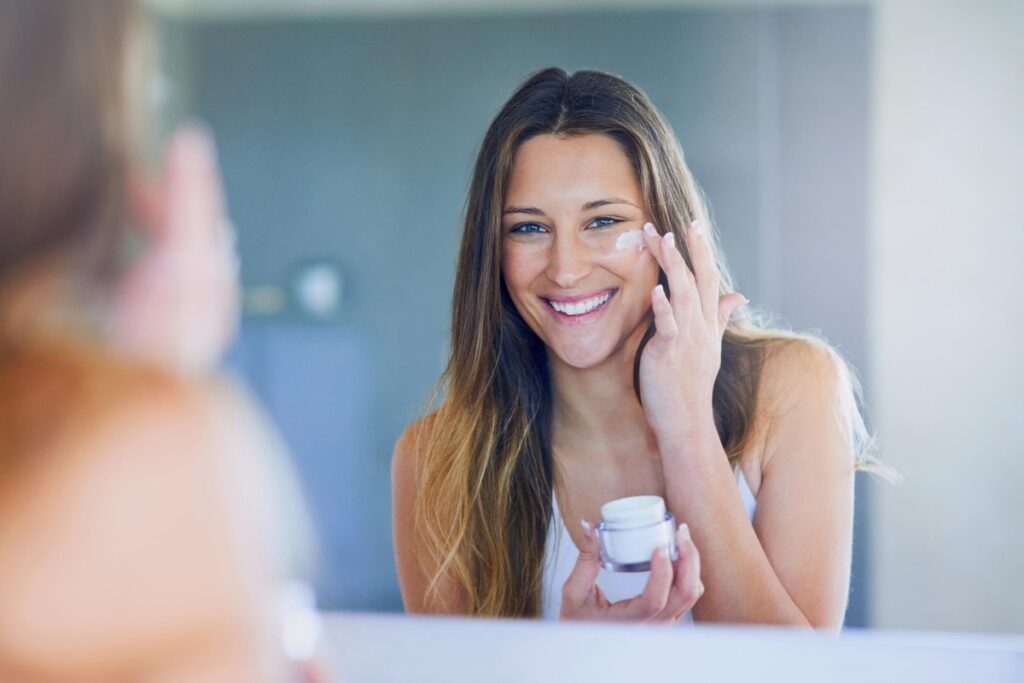
You’ve already tried a lipstick color that was supposed to flatter your complexion, but instead made you look like you hadn’t slept for three nights?
Maybe it’s because you don’t yet know your contrast. Good news: you don’t need a master’s degree in colorimetry to find out. 🙂
The theory of contrast, as Aliénor Dervanian, make-up artist and content creator, explains, is based on a simple principle: observe the differences in value on your face.
In other words? Look at the intensity differences between your skin, your hair, your eyes, and your brows.
It’s visual, it’s instinctive, and with a TikTok filter (or a good old black-and-white photo), you can self-analyze without stress.
Strong, medium, weak: adapt your makeup to your contrast
If you have a high contrast—think fair skin and very dark hair like Anne Hathaway or Monica Bellucci—the idea is to rebalance intensities.
A bit of bronzer, a well-measured blush, and a bolder lipstick can create harmony. No need to overdo it: a 2-in-1 lips-and-cheeks product can make all the difference.
A medium contrast is that “just in-between” of light and dark, like Zendaya or Amy Adams. Here, you can play with mid-tone shades: rosy blush, a soft bronzer on the lids, a lightly tinted lip balm.
The goal? Create intensity with subtlety, without going over the top.
With a low contrast—think Elle Fanning or Sabrina Carpenter—you avoid breaking the harmony. Stay within the same natural tones, but there’s nothing stopping you from wearing a full face of makeup!
A glowy complexion, a light liner flick, a luminous gloss: what matters is coherence in shades and a subtle enhancement of what you already have.
A method that evolves with you
What’s great about the theory of contrast? It adapts to changes in your life. A summer tan, a hair color change, or even the appearance of gray hairs? Your contrast shifts, so your colors must adjust as well.
And if you’ve ever had the feeling that makeup that used to suit you now looks odd, it’s likely because your contrast has evolved.
Nothing abnormal! Aliénor Dervanian notes: “That’s why we sometimes feel more beautiful in summer, because our contrast weakens and all our values become more harmonious.”
In short, the theory of contrast is a beauty compass. Not a rigid rule, but a clever tool to know yourself better and enjoy your reflection in the mirror. And spoiler: the right makeup is always the one that makes you feel good. 🙂